
Essay: “The Body is not an Abstraction: The Art of Egai Talusan Fernandez,” by Asa Drake
The Body is not an Abstraction: The Art of Egai Talusan Fernandez
The last time I visited family in Quezon City, my uncle, Egai Talusan Ferenandez, had returned to making sculptures. In one, he casts the figure using my cousin’s face. The bronze sleeping body is clothed by spider plants, a plant that in North America is loved for its ease of care and propagation, but it’s native to tropical and southern Africa. The bronze figure wears no shoes. His bare feet touch heavy loafers which touch his luggage, a gesture that echoes Tito Egai’s social commentary about the treatment and expectations of overseas workers. But in this one, the figure is not suppressed by the balikbayan box as it is in “Puhunan at Tubo.” For those unfamiliar, the balikbayan box is a way of shipping goods to loved ones. One might go so far as to say, the balikbayan box is a tradition. One through which overseas workers send home goods in their absence. As the title, “Puhunan at Tubo,” suggests, the balikbayan box represents the Philippines’ economic dependence on overseas workers, who in Fernandez’s sculpture take on the allegorical shape of “Investment and Profit.” But in this new work, the body feels loved, protected even, by a living shroud of houseplants. Because the casting makes for such an exact replica of a relative’s body, when I look at Tito Egai’s older works like “Puhunan at Tubo” I imagine, within this shape, too, is a loved one. Even, within “Kinupot,” a work created during and commenting on the “disappeared” of martial law, the body I imagine “gotten” or “bagged,” as the title of this series suggests, is one directly related to my own.
Recently, discussing our work as poets, I told Tita Nena that I'm interested in how silence can generate a productive discomfort. I often distrust the reader to imagine their own vulnerability. She sent me a video of my uncle’s "Ang Tao." And I had to laugh a little when I realized that my concerns about audience are concerns Tito Egai was already exploring in his work a decade before I was born. Tito Egai sculpted “Ang Tao”out of plaster and canvas in 1978. Like “Kinupot,” “Ang Tao” calls out to the disappeared. His generative white space is meant for an audience who might resist imagining the risk it signifies.
When Tito Egai died in 2024, it was sudden. He had just judged a community art event. He and Tita Nena had had lunch together. He had biked home and rested before dinner. I didn’t have time to fly home. Over the phone, my mom relayed what happened at my uncle’s funeral. Who ordered what kind of food and how long was the vigil and at what church. Who brought the flowers. Who stayed with Tita. Who made use of the bicycles. I recount the details because existing in community was central to his work. On weekends, Tito Egai taught workshops to students learning Baybayin, a script I’ve seen incorporated into numerous paintings over the years. Often, he worked on collaborative murals. And in 2022, he painted our rooftop with a pink dove to express solidarity with Leni Robredo’s presidential campaign during uncharitable times. Every time he introduced me to art, he made a point to also introduce me to living artists. For him, art was a practice which required artists to be in conversation with one another. My uncle’s paintings frequently depict the landscape of oppression and revolution. At times, he depicts the figure of the devil and the figure of state, but more essential to his paintings are the Filipino body, displaced and reasserted. A body that exists within and beyond national (and even supernatural) borders. Beneath the body of the Filipino martyr is the body of the Filipino farmer, and of a ghostly barangay, a community which urges the actions of the living.
So many of Egai Talusan Fernadez’s paintings bring a vibrancy to nature that is hypernatural, but his sculptures are frequently monotone, as if the human form, through political action or economic need, has been removed from the natural world. In this way they remind me of his charcoal sketches which often focus on an isolated expression of humanity. I used to see these hung on the walls by a staircase when I was little. And often, these sketches feature a body returned to the archive. For example, in the charcoal and pastel sketch of “Beew Refugee, Abra” (1987), Fernandez pays witness to the suppressed Beew Massacre, not through the burned bodies of the disappeared, but through those who might recount the violent history of martial law. The woman and child are in motion as if they are crossing the viewer’s line of sight. The subject may not see me, but I cannot ignore her.
When I ask Tita for images of Tito Egai’s art, she sends me this sketch along with images of my uncle. In one, his portrait is being taken by long time friend and fellow artist Ben Cabrera. Another image of Tito Egai is rendered using a metal plate. Tita Nena refers to this image of him as the “‘poster boy’ of Phil Social Realism a la Che Guevara.” (I love how this image allows for a certain continuity of influence, from one continent to another.) My family has this last image reprinted on black cotton t-shirts. At his home studio, Tita and my cousins gather wearing these shirts on the first anniversary of Tito Egai’s death. It’s an impossible reconstruction--the face of the dead repeated on the bodies of the living--but the duplicated image insists on the possibility that the body of the artist is not separate from the body of work. Not parallel or interspersed, the body becomes enmeshed.
Only once was the body within my uncle’s body of work my own. I was maybe six or seven when Tito Egai took me to my first gallery opening. A friend had created a huge chair that was the “seat” of Uncle Sam. Illuminated behind the chair was a separate installation of Mark Twain’s Philippine Flag as described in his article,“To the Person Sitting in Darkness,” criticizing U.S. colonial expansion. In Twain’s article the satirical flag takes after the flag of the United States:
And as for a flag for the Philippine Province, it is easily managed. We can have a special one--our States do it: we can have just our usual flag, with the white stripes painted black and the stars replaced by the skull and cross-bones.
This was my conscious introduction to the colonial state. I could suddenly name where I had always lived. Not in South Carolina or in Quezon City, but the concept that defined the relationship between these two spaces. At the exhibit, Tito Egai encouraged me to sit in the large wooden seat of Uncle Sam. This was not breaking the rules, he told me. Nor would we be disrespecting the artist. (Frequently, he encouraged me to be less concerned with the intent of unseen authority figures.) As the daughter of both countries, he explained, I could be an intentional extension of this exhibit, his own addition. I was very excited. How others perceived me could be an expression of art! I’m certain this framing of my physical body within the image of the colonial state led to my work as a writer, though it took a long time to shape my work in a way that addresses (and demands access) to an American and Southern history obscured by colonial violence (but surely present in stories of Louisiana's Manila Village and the numerous “invasive” plants of Asian origin. Consider, for example, the fuchsia azaleas and banyans dispersed throughout roadside Southern attractions). As the saying goes, we’re over here because someone was over there.
When I describe this exhibit, I frequently narrate the images. Separately, I narrate how the exhibit made me react, or how my uncle jokingly called me “import,” a word that sometimes made me cry. (I could not determine for myself if I was a colonial good, or, like the items in the balikbayan box, something precious returned home.) Sometimes I ask myself whether the images I try to remember from the gallery or the narrative of my personal experience is more useful? Are my actions alongside and interspersed with this body of work or are they parallel? But like memory, the influence of the image and the narrative are intertwined. So often, I hear a similar question regarding the work of writers and artists in diaspora. The possibility that their (our) work happens parallel to writers and artists in our heritage countries. I find it much more likely that these are not two distinct bodies of work, but an enmeshed narrative. Like Tito Egai’s work, the image is meant to echo beyond national boundaries. The work and archive of those in diaspora happens in conversation with those “at home.”
Sources
1. Fernandez, Egai Talusan. "Puhunan at Tubo." UP Jorge B. Vargas Museum. 2010.
2. "Kinupot." Ateneo Art Gallery. 1977.
3. "Ang Tao." National Gallery Singapore. 1978.
4. "Birhen Balintawak." Iglesia Filipina Independiente. 2002.
5. Ikot ng Buhay. (n.d.).
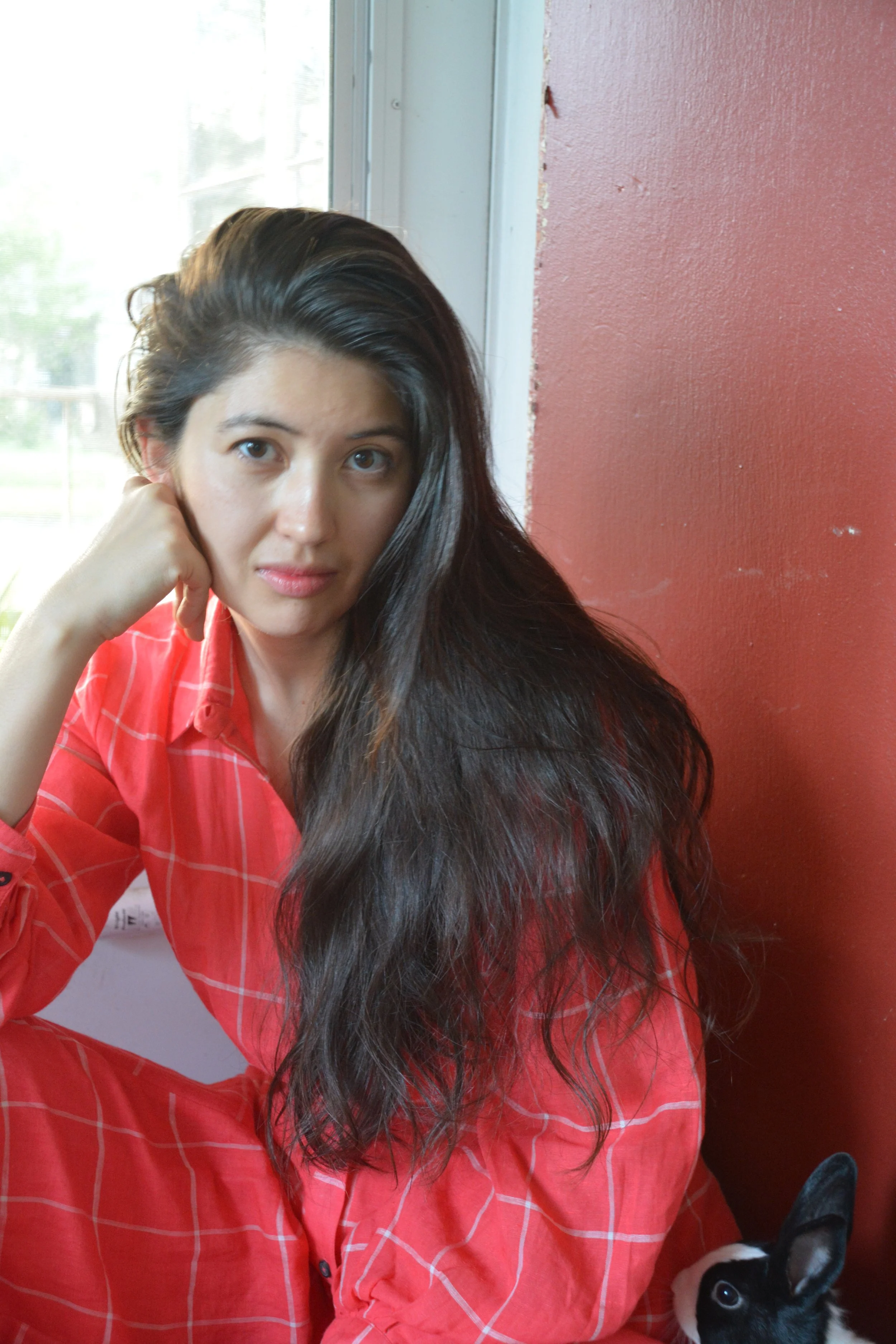
About Asa Drake
Asa Drake is a Filipina/white poet in Central Florida. She is the author of Maybe the Body (Tin House, 2026) and Beauty Talk (Noemi Press, 2026), winner of the 2024 Noemi Press Book Award. A National Poetry Series finalist, she is the recipient of fellowships and awards from the 92Y Discovery Poetry Contest, Kenyon Review Residential Writers Workshop, the Rona Jaffe Foundation, Storyknife, Sundress Publications, Tin House and Idyllwild Arts. Her poems are published or forthcoming in the American Poetry Review, Copper Nickel, Georgia Review, and Poetry. A former librarian, she currently works as a teaching artist.