
Food and Beverage: “Variations on Acquisition” by Anu Khosla
Variations on Acquisition
In the Mercato del Capo in Palermo, we sample arancini. The core of this gastronomical planet is succulent ground beef mixed in with soft but whole green peas. Wrapped around this ball of goodness is a mantle of perfectly yellow, saffron scented arborio rice. Its crust is a thin layer of breadcrumbs, toasted to a geologic shade of orange. When whole, it resembles a mound of bauxite. Cutting into it, the crust crunches like a delicate tremor in the earth. Our guide tells us that saffron was brought to Sicily with the Moors during the Byzantine era. Surely, the saffron in Sicilian arancini is seen as exotic to many. But is it luxurious because it’s exotic or is it luxurious because it’s so rare, so pricey? Most flavors are delicious always and only in the right context.
The context of arancini’s savory flavor bomb is one of historical mixing. Of encounter, of cultural blending, of empire. Of conquest which is not so distinct from the acquisitive impulse we have when we drive another push pin into our map. No, of course they are not the same. To see a place is not the same as to own a place. To know a place is not the same as to command a place.
Ursula K. Le Guin wrote, “If it is a human thing to do to put something you want, because it's useful, edible, or beautiful, into a bag, or a basket, or a bit of rolled bark or leaf, or a net woven of your own hair, or what have you, and then take it home with you, home being another, larger kind of pouch or bag, a container for people… if to do that is human, if that's what it takes, then I am a human being after all. Fully, freely, gladly, for the first time.” I’d like, very much, to put a thousand arancini into a bag, and take them all home with me.
On a Sicilian road, a car passes with the letters PEUGEO printed along its backside. I wonder what other Americans would make of this little car. Would it be considered luxurious because it’s foreign? Or would it not, because it’s just a regular car? Would it be considered shabby because it was missing its T? I’m sure many would see it as exotic, but does exoticism by necessity lend an air of luxury to things?
*
Wandering through a pleasant daze of well-lit jetlag around the Fiumicino Airport arrivals hall, the ambient purr of people speaking Italian slips into my ears like a babbling brook. I seek my baggage, but what finds me first is the sound of someone releasing bursts of English into the cavity of the terminal. When traveling in lands with other tongues, English sticks out like a neon sign in a dark sky. Some other Americans at the money exchange counter are handing over a thick stack of dollars. As they do so, they ask for the stack to please be exchanged for “the local currency.” I let a quick, condemnatory puff of air pass through my nose.
I worry, momentarily, that I am some special category of asshole for judging this person for not knowing something. But what bothers me is not their ignorance, rather the lack of curiosity it seems to imply. When curiosity is left at home, what gets packed in its place is a mindset of acquisition. Destinations become a thing to possess, a trophy to show off to others, a marker of authority. But an authority about a place slips so easily into a seeming authority over a place. Towns and countries are like Pokémon. Catch a flight, catch a cold, catch ‘em all. Sometimes this acquisitiveness has a sense of learnedness to it, where a person will use what knowledge they acquired in a place to show others how much smarter they are. They will act like they knew what was happening in that country in the 1600s prior to their visit to the museum. I may do so myself, in this essay, for example. Other times, passport stamps will be collected like looted artifacts, with near disdain for any knowledge of what they stand in for.
*
Later, the day of the arancini, we sample cannoli from I Segreti del Chiostro, a confectionary shop hidden within the Dominican Monastery of Santa Caterina d’Alessandria. Historically, the monasteries of Palermo were filled with cloistered nuns who would bake pastries with secret recipes to sell to the aristocracy of the city. Each monastery had a secret recipe which was passed on orally through generations of nuns. Santa Caterina dates to the 1300s, though the last time any nuns lived there was 2014. I Segreti del Chiostro, the secret of the cloisters, exists now –– partially in museum form, but still also in the form of confectionary shop –– to keep the secrets of the nuns, and the secret cannoli, alive.
Our group of three ordered three cannoli in the cavernous room filled to the brim with dolci. The cannoli were filled to order with ricotta, and one could choose which toppings would be dusted over their glazed and crunchy tops: pistachio, chocolate chips, maraschino cherry, candied orange peels. We three reached for every flavor. Other sweets were on offer as well. Home-printed signs on plain white paper advertised granita options with little drawings of fruit to help translate the flavors to non-Italian speakers: granita alla fragola, granita di limone, granita ai gelsi. We each opted for chocolate chips on one side of our cannoli and pistachio on the other. Two of us paired the chocolate with cherry and the pistachio with the orange peel, though one delinquent palate chose the opposite.
We ate them out in the cloistered garden. Crumbs fell to intricate tile, painted in cool colors, though chipped and dimmed through the acquisition of years. Tiny citrus––kumquats?––speckled the overstory of the garden like stars, while red and white roses huddled conspiratorially around the central fountain, topped, of course, with a marble Dominican monk, who knows how old but firmly here, now.
The cannoli were big enough to fill a whole mouth, robust and uninhibited, unlike the poncy, slight cannoli I knew from places like Manhattan. These cannoli had not been withered away by time or travel. Delicate crunch, sweet dairy, devoured.
*
Before touching down in Rome, we had to take off in San Francisco. On the plane, I watched a cool young woman speaking in the aisle with the flight attendants. The words, printed in placeless cosmopolitan font, on the back of her hoodie read: “It’s all unfolding in a state of divine timing.” I read these words before hearing her own. We were still in the US, you see, so a person speaking English didn’t have the feel of incantation yet. She was occupied, at the time, with complaining about her luggage. It’s all peace and love until the ITA Airways staff makes you gate check your bag.
How comfortable, for me, to judge my own countrywoman. As comfortable as the sweatsuit she wore, the sweatsuit that looked, inexplicably, tailored. How much more quickly I would have caught my own judgment if it had been directed to someone with a different passport than I.
Maybe this woman was just on edge about air travel. Maybe she took her anxiety out on the logistics of getting to the place, so that when she arrived she might be able to really let go, to unhand her need for control. Maybe her luggage, her objects, were just a safety blanket as she set out into discomfort. Maybe she needed a tactile grip on the suitcase handle in order to give in, emotionally, to the chaos and surrealism of an unknown place. Unknowable.
Or, maybe she just lacked self awareness.
*
Italian cities remind me of Indian ones. Marble and ruins and bodies and sweeping trees that can only do so much. Both are made up of layer upon layer of history, the ancient and the modern living atop and amongst one another in a fragile homeostasis. Like Arancini, the cities are stuffed and formed and molded differently depending on where you go. Traditionally, arancini were eaten on December 13th to mark the feast of Santa Lucia, commemorating the arrival of grain during a severe famine in 1646. Grain was acquired, just like my knowledge of it.
Every day Rome is trampled on by any number of feet. Each single sole works to wear down the ancient stone into something smooth and slippery. But Rome and Palermo and Florence and Venice also do trample on the traveler, making the heart erratic rather than smooth. Cacio, consumed, enters through the mouth to cling like a film to interior surfaces. Frascati, like a cataract, flows through torrentially and convivially. Affection strikes the bullseye, producing capillary waves of passion, sometimes musky, sometimes woody.
What do we take from the places we visit? A jar of capers. Some photos. A mental image of an ancient building that looks exactly like a modern sports arena. A new way of thinking about the semiotics of a modern sports arena. New knowledge, perhaps of what kind of wine we like, perhaps of ancient migratory patterns. A fullness. And what do we leave behind in these places? For me, a favorite pair of jeans. I try my best to bring the memory of it all back with me.
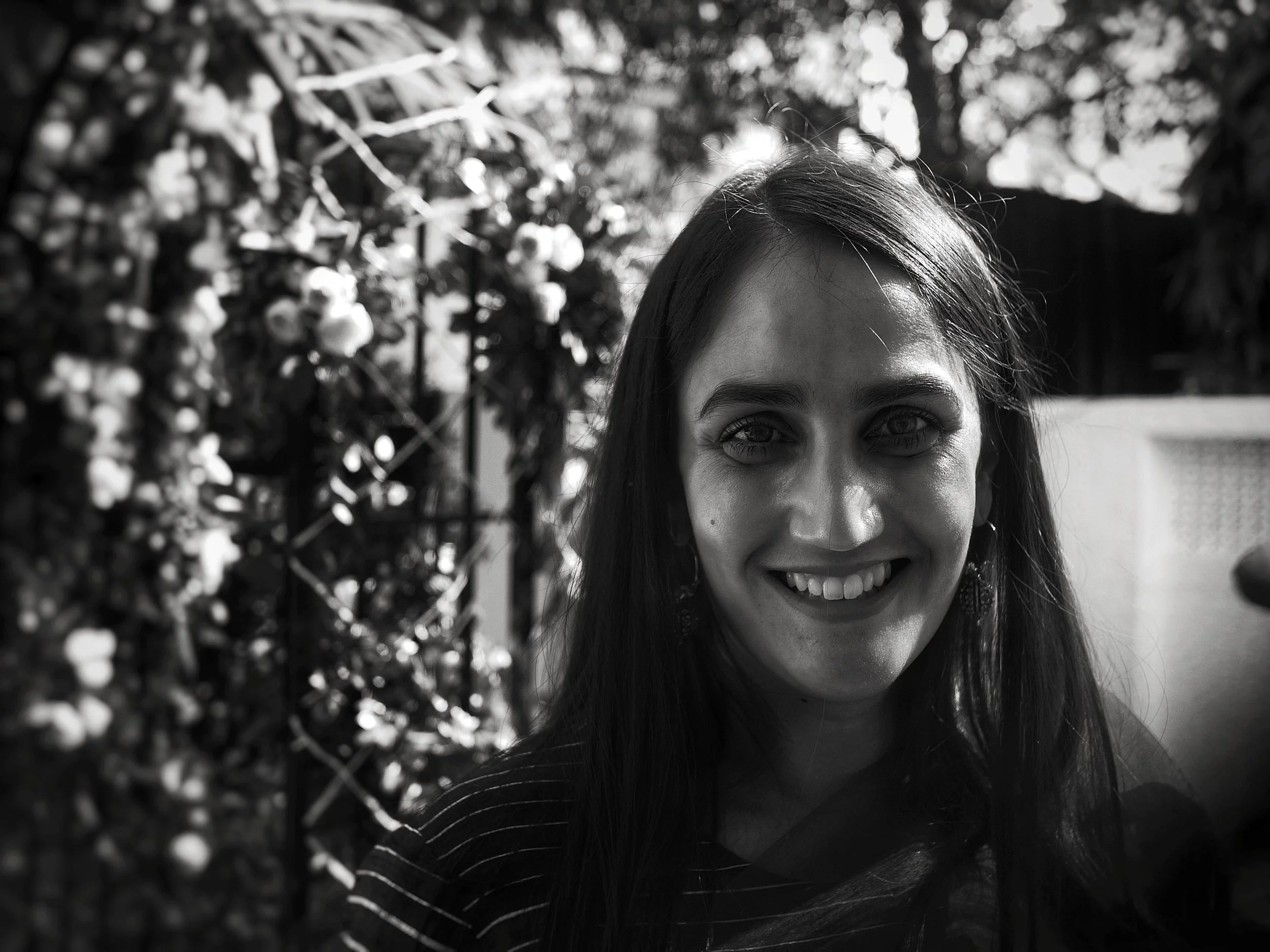
About Anu Khosla
Anu Khosla is an emerging writer and critic based in San Francisco. Her work appears or is forthcoming in The Rumpus, Wasafiri, New Delta Review, BOMB, Electric Lit, Adi Magazine, Barrelhouse, The Racket, and elsewhere. Her writing has received support from the Lighthouse Writers Workshop Book Project, the Kenyon Review Writers Workshop, Tin House, VCCA, and Ragdale.