
e·pon·y·mous: Reviews in Conversation
In collaboration with the O,Word? podcast, e·pon·y·mous: Reviews in Conversation is a companion series where Sticky Fingers will publish a poetry review one week in advance of the e·pon·y·mous episodes going live, where DeeSoul Carson discusses the reviewed collection with the poet. Subscribe to the O, Word? Substack to stay up to date on the episodes! The episode correlating with this review goes live on Monday, November 16th.
Everything the Light Touches:
A Review of Noel Quiñones’ Debut Collection, Orange
by DeeSoul Carson
What do you remember about being a child? When I think about growing up, my mind is transported back to the rainbow rug of my kindergarten teacher (I always called dibs on the purple square). I remember the teacher as our own personal Ms. Frizzle, with wild red hair and big glasses and an animated voice that was always able to transport us to another world. I remember crying when she would move the clothespin that represented my behavior from the bright green “Good Job!” square to the red “Needs Improvement” square. From jungle gyms to technicolor parachutes to class decorations, the world of children is full of color and play. Quiñones’ debut pulls from a sense of childlike wonder and channels into an opportunity for poetic engagement.
Orange is a formally-ambitious debut that explores the mess & magic of childhood & adolescence. Grounded in color theory and interspersed with familiar artifacts of youth — such as the Magic School Bus, coloring pages, & connect-the-dots — this is a collection that colors outside the lines, asking us to approach each poem as its own unique experience. Just like with color, each person will see these poems a little different, but all will find a book vibrant with life.
The book opens with a frontispiece, “Ms. Frizzle Explains Color Theory,” that, like any good teacher would encourage, scaffolds expectations for the rest of the collection. Firstly, it introduces the recurring poetic voice of Ms. Frizzle, who many 90’s kids will remember as the quirky animated school teacher that would take her class on fantastical field trips with the help of a magic school bus, visiting space, the digestive system, and an ant colony, to name a few locations.
In this book, her whimsical and instructional voice is adapted to give helpful context or knowledge to the reader as they move through the poems. In this opening poem, Ms. Frizzle lays the foundation for color theory that will inform the rest of the poems moving forward:
What if I told you light is a marriage
between what we believe and what we see —
Is my dress blue or violet, children?
And further down:
………………………………………………………………….Artists
scientists, philosophers, and holy men have argued
whether color is real or not for centuries. Tell me,
what color is your room in the dark?
In this poem, and in this book as a whole, the question of color is the vehicle by which we discuss the matter of perception, what we are capable of understanding and how what little we know or perceive informs what we make of “truth.” Running through the poems is the thread of a child trying to make sense of their parents’ divorce, combing through activity books and color charts and maps to understand the ways we relate to each other, an understanding that bends and refracts and reflects what we believe about ourselves.
The first poem of the next section immediately showcases Quiñones’ structural playfulness with “How to Color Mami,” a “Coloring Book” poem that employs a color-by-numbers drawing that asks you to fill in an illustrated flower with the colors named in the poem’s three stanzas, an enactment of the child-speaker’s conception of their mother. I was delighted when, at the book’s Manhattan launch, attendees were given a packet of four crayons (like the ones you receive with a Kid’s Menu at Denny’s) to fill out a “Who Am I?” activity sheet, which I then used to color in this poem in the book.
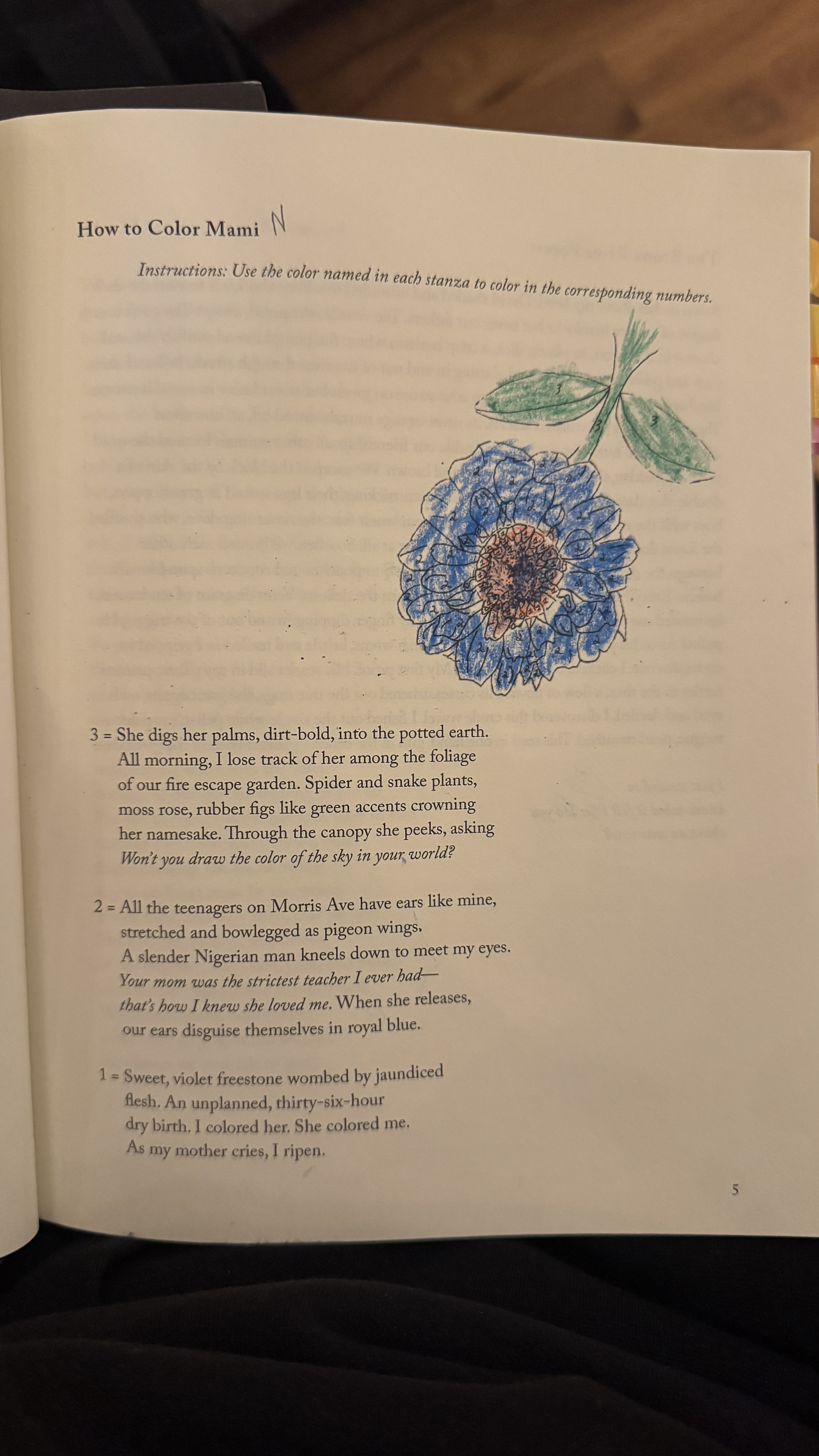
How to Color Mami
Orange by Noel Quiñones. CavanKerry Press, 2026. 104 pages.
Buy on Bookshop.org
This poem is one of many nonce forms used over the course of the collection. All throughout, the reader is encouraged to actively engage with the text, whether that means turning the book to read a poem written in a spiral to talk about violence, a poem to be read in a reflection where the speaker claims not to be their father, or a series of color wheels that act as a four-part contrapuntal. Just as much, the poet uses stichic and organic forms more familiar to us to recount narratives of queer identity, childhood escapades, and confessions to cousins. The poems take us on a journey of the speaker’s exploration of self, how structures both familiar and invented can get us closer to answering the questions we have about ourselves.
The title poem, “Orange,” opts for the received form of a ghazal, although it plays with the expectations of the form. Instead of repeating the same word at the end of each couplet, Quiñones uses different words for the color orange throughout history, allowing for the form’s repetitious structure to enact the word’s evolution and queerness:
If I have a gender, let it be a history learned from orange
Freak Sun Fucker Faggot Orange Boy
Rumor of 6-th grade sunrise, dress in you I was a child
of unspeakable obsession. Archaic language, Giolureade
Until Elizabeth of York, Queen of England. Her lips unlocked
your sarcenet line, my finger knew taste before the orange
If there was any true singular critique I had for the collection, it would be for the moments where I feel the poem’s form does not add to the poem’s content. Of course, with such a range of structural attempts happening in the collection, it is reasonable to assume that there are some that won’t resonate with every reader, and what falls short for one reader may raise no flags for another. Poetry, like anything else, is a matter of perspective.
One poem that comes to mind specifically when I think of alternative structural possibilities is “How to Connect Papi,” a foil to the “Coloring Book” poem at the beginning. This poem instead has the reader connect the dots to result in the image of the spaceship from Galaga, the father’s favorite arcade game. While the concrete shape of the ship is fun and familiar, the addition of the connect-the-dots, in this instance, runs the risk of feeling gimmicky. As a reader, I would have loved a poem that used a single word for each dot and actually had me string the words together to get a full understanding of the piece. This, of course, would have called for compression and resulted in a different poem entirely, but it is considerations like that go through my mind as I read: when does the form distract from the poem instead of reinforce it?
This aside, however, Orange is exciting in that it takes so many risks and asks us as readers to be open to exploration, open to engaging with the poems and the world with the eyes we had when we were children. Here is a collection asking us to approach poetry with the wonder, to consider what poems can do outside of the confines of the page, to remember that poetry lives in everything we engage with — neighborhoods we used to map with friends, games played with parents and uncles and cousins, the animated characters accompanying us through our childhoods. Every day, we are awash in color, and this book shows us how to take that light and make our poems shine.
Listen to DeeSoul Carson in conversation with Noel Quiñones on the next episode of e·pon·y·mous!
Orange by Noel Quiñones. CavanKerry Press, 2026. 104 pages.

About DeeSoul Carson
DeeSoul Carson is a poet, educator, and host of the O,Word? podcast. A Stanford alum, his work is featured or forthcoming in POETRY Magazine, Muzzle Magazine, AGNI, & elsewhere. For his work, DeeSoul has received a National Endowment for the Arts and a Ruth Lilly and Dorothy Sargent fellowship from the Poetry Foundation, as well as fellowships from the NYU MFA program, the Watering Hole, and the Sun Valley Writers’ Conference. His debut full-length, The Laughing Barrel, is forthcoming from Alice James Books in Spring 2027. Find more of his work at deesoulpoetry.com.

About Noel Quiñones
Noel Quiñones is an Emmy award winner and author of Orange (CavanKerry Press, 2026). Their work has been published in Poetry, Boston Review, Poem-a-day, and the Michigan Quarterly Review. Their short story "This Time and the Next" will be included in The Best Short Stories 2026: The O. Henry Prize Winners. A graduate of the University of Mississippi's MFA program, Noel is currently a JFMS Screenwriting Lab Fellow, working on their first TV show.