
Pasts and Possibilities, Resurrected:
A Review of Meghana Mysore's Let All Our Ghosts Depart
by Tiffany Mi
Meghana Mysore's Let All Our Ghosts Depart is as fierce and honest as it is whimsical.
This collection of stories quilts together the voices of women and girls across the South Asian diaspora who reach for what was, what could have been, and what might be once more. In the distance of that reaching, anything can be possible.
Imagine, for instance, you watch your dead grandfather get a haircut inside a Denny's while you dive into a stack of cinnamon pancakes, as in the story “Hair Bright as The Moon.” Or, as in the story “Hoarder,” you hold onto past beloveds as scarves. What happens when an accessory, which might otherwise be the lightest thing you might wear, becomes the center of gravity in a narrative?
In the tradition of invoking literary ancestors—from Lucille Clifton to Anne Carson to Sylvia Plath—that Mysore has set up across these pages, I'd like to connect her work to another: Bhanu Kapil. In her hybrid work Incubation: A Space for Monsters, she says: “Did you ever feel as if the inside of your body was on the outside, like a pair of earrings, or a dress?”
As much as these stories explore inheritance, belonging, womanhood, love, and the afterlives of all the above, they are deeply embodied. What does it mean to be deemed “other,” to be objectified, or to be assigned a particular set of functions society demands of you, or to be desired, or to desire, while living in this body? What is the role of agency in all this? As a second-generation Asian American woman, I resonated with how various characters across life stages grappled with these questions in their daily life, as well as with the question of time.
Diasporic, intergenerational, speculative, and nonlinear time.
As someone still figuring out, at 29, what it really means to “come of age” in a country that has inherited me, I was delighted by stories like “Blood and Bone,” “Repair Shop,” and “Love Letters,” which reflow chronologies in ways that refract new meanings from the past into the present. In the former, a young woman's dead father is still able to Face-Time her all while aging backwards, toward the instant in his like in which he felt the greatest sense of possibility. Near the end, and yet in some sense all along, there is a message he would like to share with her, before which he calls her what he has always called her:
“Mari,” he said. It was strange for someone only twelve years my senior now to call me his baby daughter.
These words, and our narrator Parvati's question for her dad on their next call (“How old are you today?”), are arresting not simply because they insert the strange within the familiar, but because they allow us to disengage with the dominant logics of capitalist time, and all the more so in a story that pares back the real consequences of overwork and the structures, internal and external, which enable them.
These relational comments on time gracefully echo many other stories in the collection, including, “A Sweater for You.” In one particular moment, our narrator, this time an elderly lady named Mamatha, accidentally reflects aloud to her son that she has become him as a child. He is cleaning her feet and can hardly understand her words most of the time; and although she is losing her body's faculties, we readers have the private privilege of following her complex reflections of the past that grow ever-lucid as they catch up with her to the present. Mysore employs shame and deep longing as opposing forces that spin together into a kind of double helix, tonally.
Kapil, again: “Shame, perhaps, is related to domination, and to being dominated, but also to the moment — always missed — in which speaking up might be possible.”
And yet somehow, even when that moment is missed, Mysore has a way of resurrecting it. How else could it be that ghosts in their various forms are the hallmark of these stories? Listen to them, look for them; they have already been whispering to each other.
Listen closely to their voices, and you may just find that a character who appears as someone else's late mother, was once a little girl whose playful, colorful imagination we get to see in yet another story.
Listen closely, and you might track a recurring concept of theatre, and Bollywood films, that both add an intimate, textured sense of nostalgia, while inviting you to wonder what it means to perform in a gendered family role, or in a relationship, or even as the version of yourself you had always dreamed to become, or to remain as.
Listen to the subtle but persistent sound of knitting across these pages. Knitting, perhaps as self-expression, especially when speaking was forbidden. Knitting as resistance, as remembering, as reaching. For whom? May you begin to find an answer in the contours of this book.
Let All Our Ghosts Depart released with West Virginia University Press on September 1st, 2026. Order your copy here!
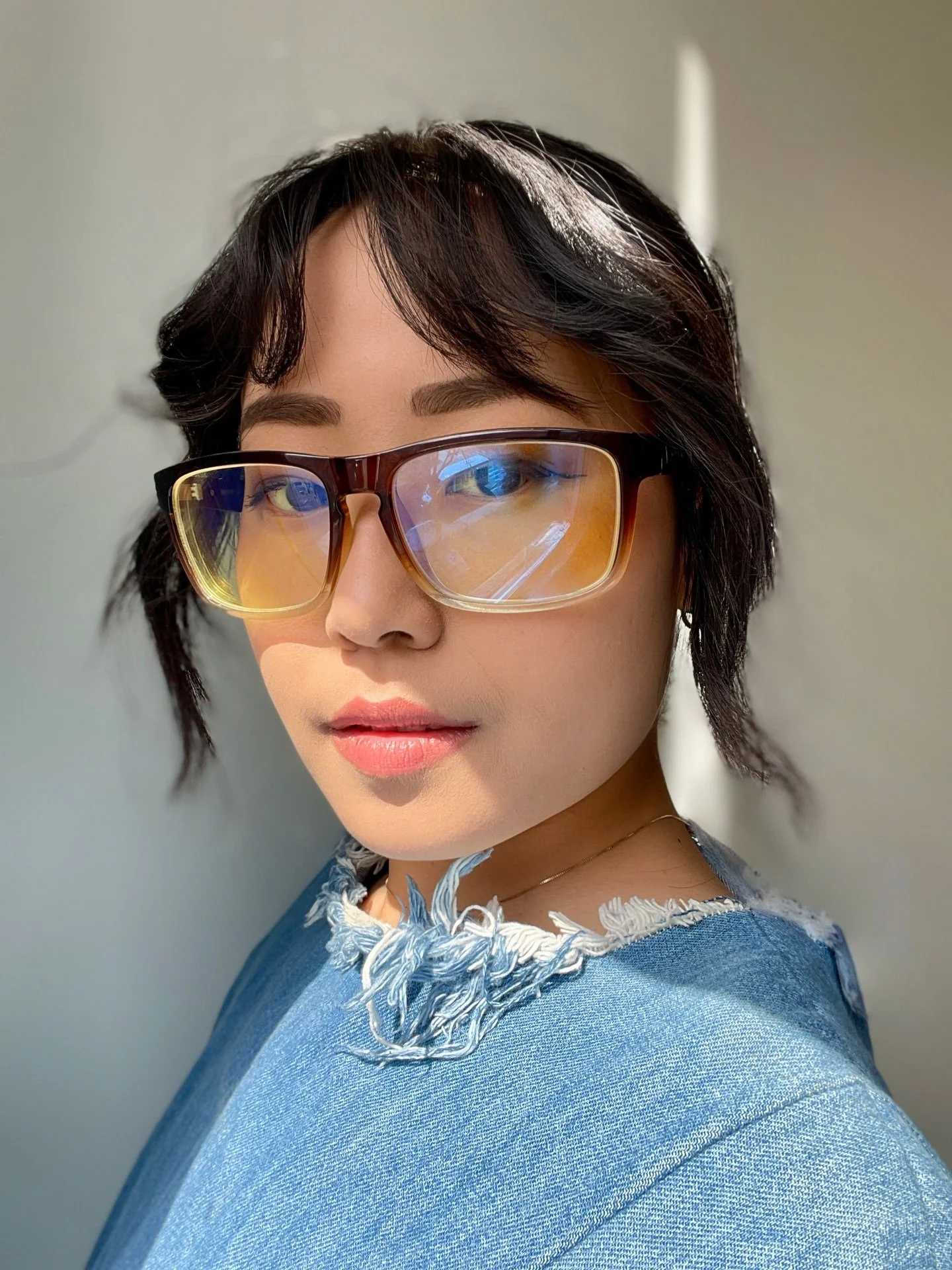
About Tiffany Mi
Tiffany Mi is a poet, writer, and Kundiman South Regional Co-Chair from Texas. Her work has appeared in Poetry Northwest, The Missouri Review, and Nimrod International Journal and has been supported by the Stadler Center for Poetry, Brown Arts Institute, and Brown University, where she received an MFA in Literary Arts.

About Meghana Mysore
Meghana Mysore’s stories, essays, and poems have appeared in The Yale Review, The Massachusetts Review, The Audacity, and more. She is the winner of the Barry Hannah Prize in Fiction. Mysore has been a Steinbeck Fellow and a scholar at McCormack Writing Center and Bread Loaf. She holds an MFA from Hollins University and a BA in English from Yale. Mysore has taught as visiting faculty at Amherst College and Bucknell University, and is assistant professor of English and creative writing at Randolph College in central Virginia. From Portland, Oregon, Meghana is a lover of non-sequiturs and used bookstores. Find out more about her at her website here.