
Last Call for Songbirds: A Review of Anthony Thomas Lombardi’s Debut, murmurations
e·pon·y·mous: Reviews in Conversation
In collaboration with the O,Word? podcast, e·pon·y·mous: Reviews in Conversation is a companion series where Sticky Fingers will publish a poetry review one week in advance of the e·pon·y·mous episodes going live, where DeeSoul Carson discusses the reviewed collection with the poet. Subscribe to the O, Word? Substack to stay up to date on the episodes! The episode correlating with this review goes live on Monday, October 5th.
Last Call for Songbirds:
A Review of Anthony Thomas Lombardi’s Debut, murmurations
by DeeSoul Carson
By some unfortunate stroke of fate, I had never heard of Amy Winehouse before she passed. Could be the fact that my biological mother listened almost exclusively to reggae (by which I mean she had the Bob Marley discography on repeat and occasionally spoke in a mildly-problematic accent). Could be that when I moved to live with my dad, most of our musical exposure was a mix of 1) gospel music 2) my step-mother’s rotation of Mary J. Blige, Jill Scott, and Sade CDs 3) my father’s 80s & 90s hip-hop & funk or 4) the kid-friendly stations of Sirius XM. Could be that I simply was not grown enough to be listening to her music.
My discovery of Winehouse was an accident. I was a big fan of VH1’s Pop Up Video (what can I say, I’m a nerd, I love trivia), and featured in the first episode of the show’s 2011 reboot was Amy Winehouse’s “Rehab,” from her second studio album Back to Black. There were so many things I didn’t know when I first heard this record. I didn’t know much I would struggle with coming to terms with my sexuality in a God-fearing home. I didn’t know that by the time this episode first aired, she had already been gone for three months, the same age that I am now. I didn’t know that all through undergrad, I would bike home crooning her music poorly to myself, victim of my own serial yearning. What I knew was that her music had a loneliness I could relate to, a sadness that didn’t necessarily feel like resignation. Her emotional burdens weren’t given to us to pity; they were given because they were honest, and she didn’t have another way to be.
Lombardi’s debut, which features so much of Winehouse’s voice and spirit, inspires a similar connection, a throughline of a product of one’s many years of wrestling their own demons, whether that be heartbreak or sexuality or addiction or the many tiny devils standing on our shoulders from time immemorial. Lombardi is nothing if not earnest, and these poems showcase a lyric that is both effusive and calculated. Many of the poems in this book are sweeping, but the choices in them are clear & intentional. A good artist knows that there are no words wasted when the tune is just that good.
Typically, I would venture away from describing anyone's work as "musical," for fear of cliché, but that's the best word to use here, for how deeply attuned Lombardi is to the sonics of the work, for the terrific flight and tumble and pulse of these poems. I was initially daunted by the size of this collection (tome, really), but very quickly I knew I was in good hands.
The book opens with “self-portrait as murmuration,” which I know from conversation with Lombardi was the last poem written for the collection. It is a five-page poem that dances across the page, changing direction as one might expect of a flock of starlings dancing in the wind. The poem introduces us to the softness of Lombardi’s verse, the clarity of the quiet that carries us through the collection:
i am too young
to know any space small enough
to contain me. my mouth
holds rain like streets
full of holes.
The poem is a series of memories, all the first: arriving, limbs, seasons, sainthood, all delicate and true enough to hold in a bird’s beak. It grounds us for the music to come, for the shifting face of grief and love.
The first poem after this, “fragments from Amy Winehouse’s stepwork journal,” is one of the twelve title-sharing poems dividing the book into just as many sections. The poems, which imagine a Winehouse that lived to work through her addiction, are all found poems, whose wide language is all sourced from the lyrics of her two studio albums. The variety of the work is, of course, a testament to the mastery of Winehouse’s pen, but it is just as much a testament to Lombardi’s ear for the songs underneath the well of her discography. The poems do not read as recreations of Winehouse’s music, nor do they feel completely divorced from the complicated figure she was known to be. These poems are the evidence of a speaker that spent significant time with Winehouse’s music and distilled it down to her spirit, to a kind of camaraderie that reached across any difference of experience and empathized with any similarity.
morning found me, a hard
break, all but breathing. the birds were so
silent they disappeared
Lombardi writes in this poem, and it is both voices speaking at once, his and Winehouse’s and anyone who has felt the hand of a rough sunrise on their back. Much of this collection works as an homage of sorts, not just to Winehouse but to the whole work of addiction & recovery, poems that touch on the ghosts we feed and the ones that push us forward.
The book ends with a second “self-portrait as murmuration,” music closing us out just as it welcomed us. The poem, which is in reference to Billie Holiday, reads like the Blues, a song we sing to remind us of all the little songs we’ve sung, the songs that get us through the lowest of our days.
I don’t know what to do
with my tenderness
Lombardi writes, but we do. The book is evidence: you take your tenderness and sing. Take flight. Find a flock and dance through the night sky. Reading any book jacket, you just want to know if you should read the damn thing. Here’s your answer: Read this one. Read it again.

About DeeSoul Carson
DeeSoul Carson is a poet, educator, and host of the O,Word? podcast. A Stanford alum, his work is featured or forthcoming in POETRY Magazine, Muzzle Magazine, AGNI, & elsewhere. For his work, DeeSoul has received a National Endowment for the Arts and a Ruth Lilly and Dorothy Sargent fellowship from the Poetry Foundation, as well as fellowships from the NYU MFA program, the Watering Hole, and the Sun Valley Writers’ Conference. His debut full-length, The Laughing Barrel, is forthcoming from Alice James Books in Spring 2027. Find more of his work at deesoulpoetry.com.
About anthony thomas lombardi
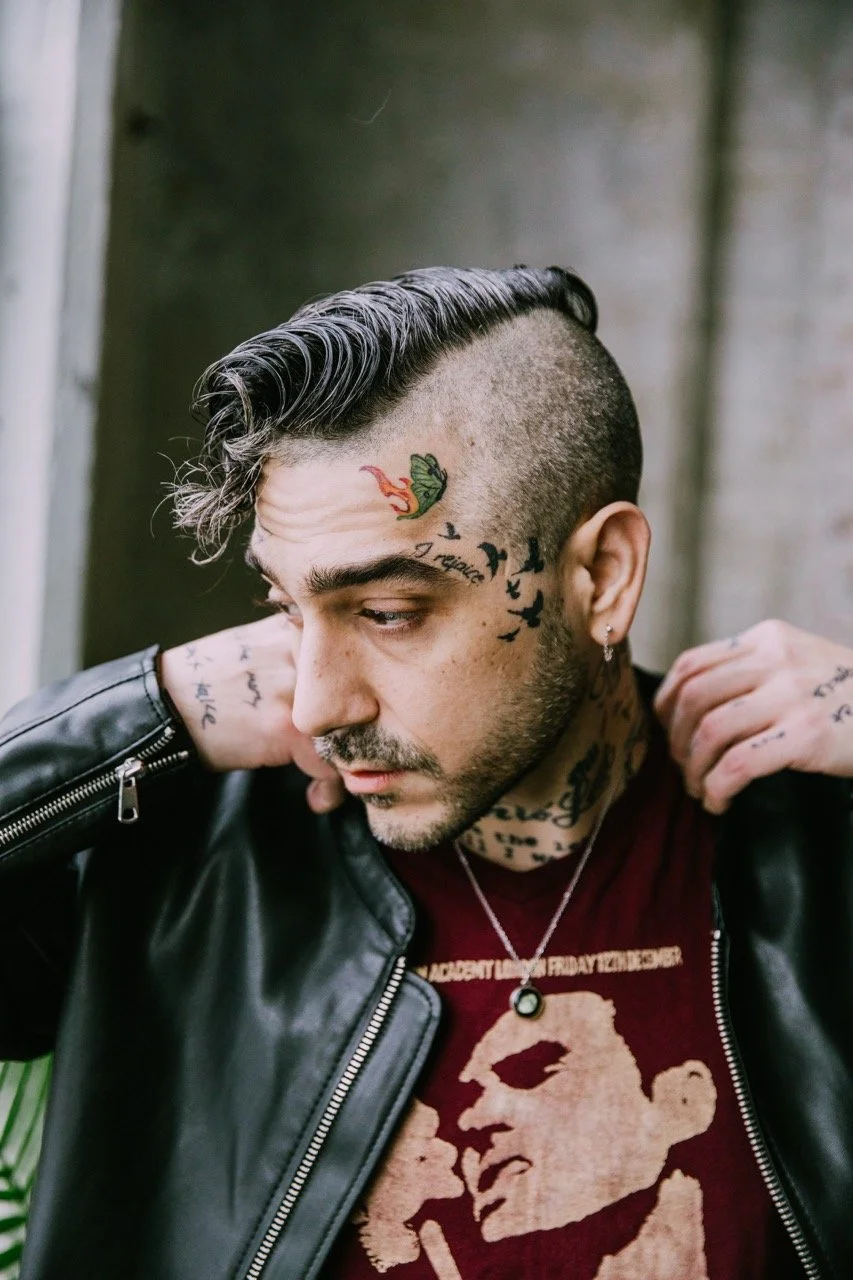
Anthony Thomas Lombardi is a writer, educator, organizer, & romantic in revolt. He is the author of murmurations (YesYes Books, 2025); runs Verses & Voltas, a pedagogical poetry service specializing in mentorship programming, manuscript consulting & feedback, & more; & has taught or continues to teach with Borough of Manhattan Community College, Paris College of Art, Brooklyn Poets, Florida State University, & community programming throughout New York City. His work has appeared or will soon in Best New Poets, Ploughshares, AGNI, Missouri Review, Black Warrior Review, Nashville Review, Narrative Magazine, & elsewhere. From Brooklyn, he now lives outside Philadelphia with his partner & their myriad critters. He believes in a Free Palestine & thinks you should too.